Voice to the voiceless

I thoroughly enjoyed the readings for this week and I was particularly inspired by the words of Diana Taylor. Taylor’s work made me reflect on Mexico’s relationship with its Pre-Hispanic history and how we relate to it. In dealing with out past we tend to have a conflicting and contradictory relationship: oftenly rushed and diminished in our primary education; part of our language, cuisine and traditions; exalted by our Government internationally, yet ignored and oppressed by it internally.

And what about the archives and museums? A good part of them were built and conceived with a Colonial mindset that still permeates and reaches many aspects of our lives. How can we reimagine our archives? Is it possible to rebuild these structures in a more organic way where we give the indigenous communities the power to tell their stories?

The Mexican Government owes a great debt to its indigenous communities. Giving them the resources they need in order to reclaim their identity free from Colonial infrastructures is of extreme importance. We should reinvent our archives and we should do it by giving voice and agency to those who have been silenced.


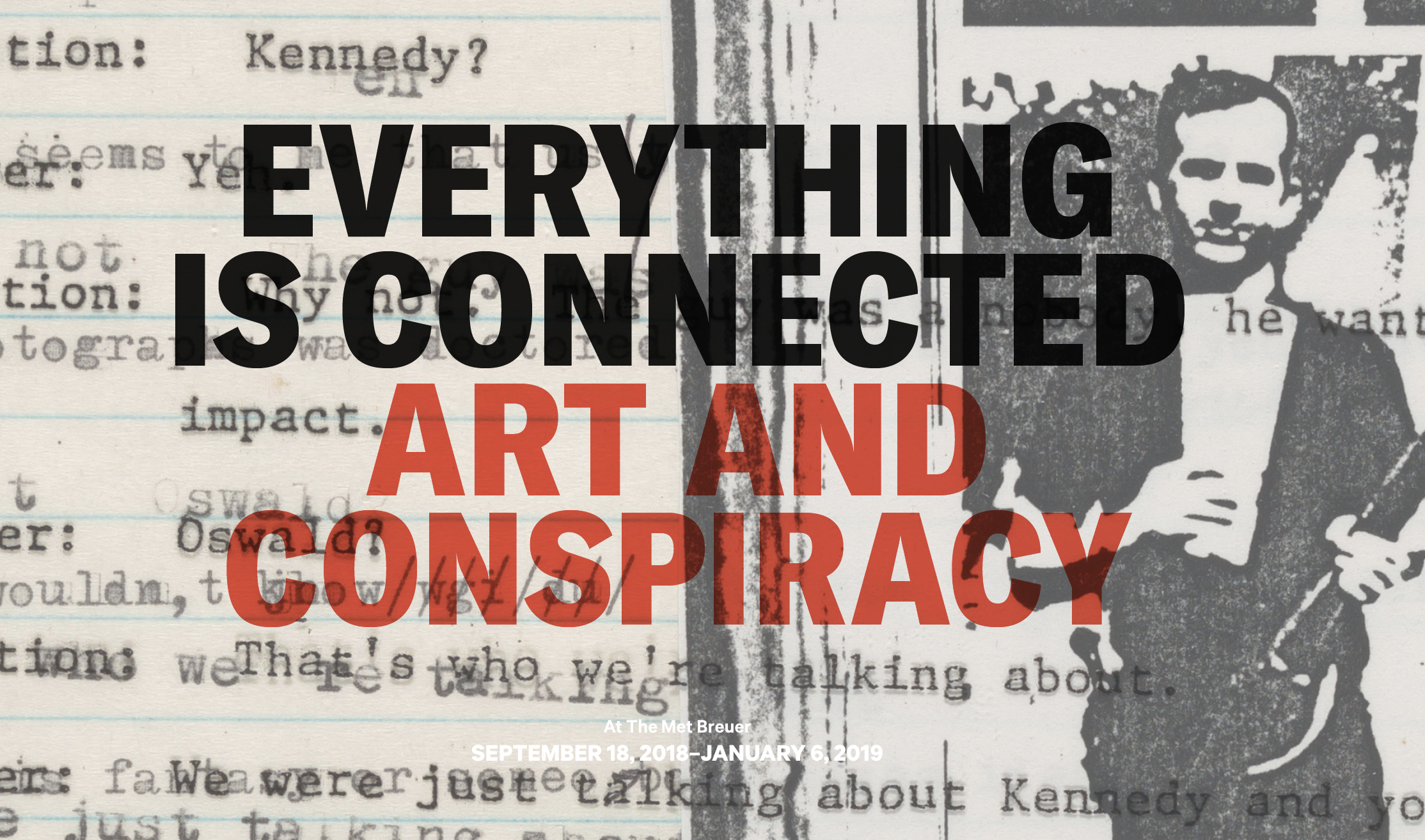
Everything Is Connected: Art and Conspiracy @ the Met Breuer

@ Met Breuer through January 6, 2019

See the museum’s website

Gallery Talk Tuesday October 30, 12:30-1:30pm

For the last fifty years, artists have explored the hidden operations of power and the symbiotic suspicion between the government and its citizens that haunts Western democracies. Everything Is Connected: Art and Conspiracy is the first major exhibition to tackle this perennially provocative topic. It traces the simultaneous development of two kinds of art about conspiracy.

The first half of the exhibition comprises works by artists who hew strictly to the public record, uncovering hidden webs of deceit—from the shell corporations used by New York’s largest private landlord, interconnected networks encompassing politicians, businessmen, and arms dealers. In the second part, other artists dive headlong into the fever dreams of the disaffected, creating fantastical works that nevertheless uncover uncomfortable truths in an age of information overload and weakened trust in institutions.

Featuring seventy works by thirty artists in media ranging from painting and sculpture to photography, video, and installation art, from 1969 to 2016, Everything Is Connected: Art and Conspiracy presents an alternate history of postwar and contemporary art that is also an archaeology of our troubled times.

The Good Life: the utopian “no place” of email archives

Susan Breakell makes the point that “to archive” was not originally used as a verb; rather the word became one around the same time as the entrance of the PC into our homes and lives. We use the word both to mean to store records, and to store electronic information that we no longer regularly use. Zielinksi highlights that “the archive serves to organize mental and enforced orders in the shape of appropriate structure and to preserve, with a tremendous amount of effort, the memory of past orders.” And from Mattern we see that archives demonstrate the interconnected technological, social, intellectual, architectural infrastructures required. This embodiment is entwined with certain politics and epistemologies, and particularly takes place in large part through aesthetics.

“The Good Life” is a project by artists Tega Brain and Sam Lavigne, an archival performance art that positions your email inbox as the stage. It is based off a proportion of the emails sent between Enron employees in the late 1990s to the early 2000s. This large-scale archive of emails was the first of its kind, and was the training database used for many early natural language processing (NLP) algorithms – including most current spam filters, and early versions of Siri. By allowing your inbox to be hijacked for a period of time of your choosing (between 7 and 28 years), you too can embody “The Good Life” of white collar, mainly white, mainly male, corporate workers (and some criminals) though language-based architectures of late 90s corporate culture. In doing so, we can all explore the enduring nature and wide-usage of digital archives, “the impulse to archive” against “the right to be forgotten,” the inescapability of bias in training data sets, and the aesthetic of emails, the poetry, and the “rational” world order of this corporate elite.

Enron started out as an energy company. Based in Houston, Texas, it was considered “America’s most innovative company” for six years in a row. It employed 20,000 people, and in 2000, the year before it collapsed, it claimed revenues of $101 billion.  It embodied a vision of American corporate success, constantly scaling and growing, moving from energy into creating new financial instruments, from trading to investments in broadband. Right before its collapse, was in partnership with Blockbuster to stream movies online – it could have been Netflix. In 2001, its stock price collapsed, and in the fallout, the company and its executives were found to have been involved in price fixing, misrepresentation of earnings, institutionalized accounting fraud, and generally corrupt business practice. When it declared bankruptcy, it was the largest in American history.

As a consequence, the Federal Energy Regulatory Commission (FERC) acquired the company’s data, including the massive archive of emails that had been sent to, from, and between employees – 1.6million emails in total. After complaints, some of these emails were removed from the archive. We can consider this a form of selection and curating the archive, though as Breakell notes, “any selection process is problematic.” One hundred employees were given 10 days to search through and remove personal emails (of their coworkers, their friends, their family members, their children). These workers were told to search for terms like “social security number” “credit card number” and “divorce”. However, as you can still find emails sent between divorcing spouses and flirting coworkers through The Good Life’s database, it’s clear many of these searches were not particularly effective in their task. The archive of 500,000 emails was the first large scale archive of its kind to be made publicly available. It is still one of the only large public email collections that’s easily and freely accessible online.

As Hal Foster writes, “no place” is the literal meaning of “utopia.” The artists’ project’s name, “The Good Life” speaks to Hal Foster and Breakall’s point – in the “no place” of the archive, we see the archival impulse go further: we can imagine “possible scenarios of alternative social relations.” To fully experience “The Good Life,” you can opt in for your own email inbox to receive a slightly reduced version of the archive. You can have 225,000 emails in total sent to your inbox in the order and with an equivalent time-spacing they were originally sent. Originally the project provided the option to have the emails sent over 5 days, 30 days, or 1 year, but these tiers had to be canceled because the emails kept getting blacklisted as spam. Given that modern spam filters were originally built off this database of emails, this seems ironic. Now, your options are to sign up to receive the emails every day for 7, 14 or 28 years.

Beyond an examination of the banality and volume of email even from its earliest usage, the project brings into play a much deeper critical commentary on contemporary digital archives, perhaps especially unintentional ones. First, we can consider the political, social, and cultural architecture of an archive, the importance of archives, and the enduring legacy of this particular database. Finn Brunton notes “the FERC had unintentionally produced a remarkable object: the public and private mailing activities of 158 people in the upper echelons of a major corporation, frozen in place like the ruins of Pompeii for future researchers.” As the first of its kind, it has been used to train spam filters, email recognition technologies like prioritization rules in your inbox, fraud detection, counterterrorism operations, and workplace behavioral patterns.The hegemonic ordering of an archive that Zielinski writes about is very much alive and enduring. There is a good chance that at least something on your phone is running off software that used this archive as its training database.

It matters then, that the users from which this archive was generated were from a particularly narrow group of people. This archive was used to build NLP algorithms because it was assumed to be representative of how people use email. But algorithms are only as good as the data provided, even or perhaps especially when they are on a large scale. As we discussed last week, biased inputs can generate and embed biased outputs in both allocation and representation. What cause for concern does it give us that so much of the epistemic scaffolding of our current information management systems are built off the corporate (and at least somewhat corrupt) working elite of the 1990s and early 2000s? On the other hand, as artist Mimi Onuoha has pointed out, today many our current datasets are built off the personal data of those who have no choice, or limited choice but to sign away their data, typically the structurally disadvantaged. This archive then offers a rare view into a group of users normally afforded more “privacy” than most people.

However, it is clear there was still a personal cost. The scrubbing of the archive did not clear out, for example, a named husband and wife emailing each other as their divorce proceeded. Employees may not have been aware in 1990s that their emails would ever resurface, least of all for public perusal. It is likely that corporate practice has changed since this time with increased awareness of the permanence of emails – the concept of “huddling” in corporate culture today is to take something offline, to communicate without leaving a digital trace. And even though we all know on an abstract level that email is not private, most of us today would still be deeply uncomfortable with our emails being publicly available in a searchable format and with our names attached to them, even though we operate with some awareness that this is possible. While it is clear that this email database deeply embodies the archival impulse, it also speaks to the right to be forgotten.

Though we might ask if that is realistic. We are now all contributing to digital archives many many orders of magnitude larger than these 500,000 emails of the Enron database. Every email, click, like, hovering over a link, and many other forms of our digital footprints are now collected by the biggest (and some not so big) corporate players in the world. What machines are ultimately being trained off datasets produced by our digital labors, and what implications does this have for both material and immaterial orders? Is anarchive even possible in this terrain? The artists suggest that by rendering your inbox into a timewarp between 1998 and present day, you subvert your email provider’s algorithm’s ability to make accurate sense of your data. Their “service obfuscates your personal emails, and it breaks the machine learning’s algorithms for understanding you.” They add: the real benefit is that it also makes it impossible for you to use your email.

Though there is a strong case to be made for examining the material infrastructure required to enable email technologies, for most people, emails appear largely through immaterial means. And yet, clearly they too operate at an aesthetic level. The Good Life’s commitment to replicating the Enron employee’s experience is achieved through the Windows 1995 interface. And while we might imagine email as standardized communication, the variation in content is analogous to Zielinski’s write up of VALIE EXPORT’s work. Formally similar frames can bring to the forefront the heterogeneity of what is contained, in this case in emails. In teaching the machines how to “think” through human language, this archive is showing a range of human communications. Granted, this is limited both by it being explicitly written content (which differs greatly from human speech, for example) and by the narrow collection of humans whose “labor” was used to generate this.

Mattern writes of a critical reviewer of an early article at pains to point out that highlighting the aesthetic experience might suggest that poetry is devoid of “intellectual or political engagement” and to fail to acknowledge that “poets even think rationally.” Given the current political debates about whose speech is considered “rational” and “unemotional” I thought it was telling that artist Constant Dullaart and NYU data scientist Leon Yin created an experiment with Brain and Lavigne’s project – a predictive text generator based off the Enron corpus. When the generator was fed a “poem” (itself found in the Enron database), it emulated the speech patterns of the emails to create this rather poetic response:

 …I put my arms in front of me

The company, that Enron companies,

the service of the company

so the company

so the company seedness.


And went to pull her nearer

To the CIO,

The CCPM

Please no California

Thanks company

And the company

So the company.


And realized that my new best friend

Business conceding the company

so the company

so the company

so the companies seedness.


Was nothing but a mirror

Of the company

So the company.
Alternative archiving (art?)

Echoing Lena’s remark that archival material intrinsically requires a re-presenting or recontextualization by virtue of expanding time and space, I want to call attention to Susan Breakell’s understanding of trace and the role it plays physically and metaphorically in art-making. Shannon highlight’s Ann Hamilton’s expanding notion of the archive that takes into consideration the labor practices in archiving and art-making: “the way the body through physical labor leaves a transparent presence in material and how labor is a way of knowing” reminds me of Ernesto Klar’s Invisible Disparities performance project. While Ernesto may be part of the “will to dust” endeavor (Invisible Disparities involved the collection of dust from a number of countries and the subsequent fusion of this collection into one “anthropic rock”), I think there is value in looking at the labor of small units or traces of matter (I’ve also had a class with Ernesto and can attest to his sincerity and anti-elitism!). The idea of traces is also palpable in a Jennifer Reeves film, Landfill 16. Reeves buried the footage underground before editing it, allowing traces of fungi and enzymes to leak through the layers of light and image. These traces of matter and mortality are definitely present in Bill Morrison’s nitrate film work.

The Aesthetics of the Digital Archive: Navigating through the Sublime.

PRESENTATIONhttps://docs.google.com/presentation/d/18E8OmOfcbexfmQ1GjIZrqu2FT0M3gr3ApiEK3oTztXU/edit?usp=sharing

This week’s reading focused on art practices that are inspired by the archive — aesthetic strategies that place the epistemological aspect of gathering and ordering documents at the foreground of the artworks. In my presentation, I will concentrate on the digital archive. I will survey different approaches artists take to represent the characteristics of the digital record: its vastness, fluidity, obscurity, and materiality.

I will start with an anecdote from my childhood. When I was eleven or twelve years old, I found out about the Internet by a TV show that advertised its new website. We didn’t have an Internet connection at my home yet, but I was very curious about it. The obvious thing to do at the moment was to start to fill a notebook with all the websites I heard of, so when I did get an Internet connection, I could check them out. By the time my house was connected to the net, this list had long become obsolete. I was frustrated and fascinated by that. Of course, I could have the same failure if I was ever to try to write down all the books or music disks I can think of, but the Internet encompasses additional characteristics: it grows exponentially, and for the common eye, is intangible, invisible, and uncatalogued.

Many artists focus on that note: the parallel, or translation, between the physical and the digital archive; between the human-scale collection, and the incommensurable scale; between the classic encyclopedia set and Wikipedia. The artist Michael Mandiberg approaches this subject with the work “Printing Wikipedia”. In 2015 Mandiberg wrote software that transforms Wikipedia’s entire English-language database into 7,473 volumes of 700 pages (as it existed on April 7, 2015), making the volumes available to print on demand. Mandiberg’s intention to visualize the large accumulation of knowledge is for me beautiful in its failure. Not only did he place in the installation only a few printed volumes, but by the exhibition opening time, the work was already outdated. To actually transform Wikipedia into tangible words on paper would demand many “crazy” printers that in real time spill prints of pages as they are edited, filling the room with unordered sheets, as in Christopher Baker work’s “Murmur Study”, where he prints live tweets, or Jason Huff’s work “Endless Opportunities,” which I will show shortly.

In the same year Ai Weiwei created “An Archive”, a collection of 6,830 rice paper sheets of printed tweets, a physical chronicle of his social media activity from 2003 to 2013. With this gesture Weiwei also materializes the fleeting and forgettable condition of the digital archive, in this case, the personal one we create on social media.

Also focused on the fleeting aspect of social media archive, Liat Segal created in 2014 the sculpture “Confessions Machines”, an ultra-violet printer that displays on a UV sensitive surface, confessions made as posts on the Facebook platform. Segal points out with this work the immaterial condition of digital files, and the short exposure life our words have in a digital ecosystem where they are constantly buried by newer ones.

Similarly, Cristopher Baker investigates the personal voice in the large digital archive, in this case on the YouTube platform, in “Hello World! or: How I Learned to Stop Listening and Love the Noise”. In this piece, Baker not only exposes the multiplicity of voices but also questions how the archive platform format shapes or influences the content itself.

Focusing on the short-lived aspect of the digital archive, on the lack of a discernable unique, but from the catalogue point of view, Jason Huff explores in “Endless Opportunities” how image results change in relation to a single keyword in search engines. Huff developed an algorithm that searches for changes in image results algorithms and prints the results onto paper.

With a similar focus in change, Dganit Elyakim, Batt-Girl, and Eran Hadas created “Wikiland”, an interactive installation that approaches with humor the narrative dilemma in the Commons. As Siegfried Zielinski points out, the archive accounts for the externalization of historical consciousness. The archive represents a voice, a political position. In “Wikiland”, viewers physically fight in order to change the most disputed Wikipedia articles about Israeli geography, and consequentially, the political position of the archive.

Although fractured, created by different authors, and dependent on different bodies, digital archives construct narratives. Many artists have focused on the characteristics of these voices. In 2017 Zach Blass created “Im here to learn so”, a four-channel video installation based on Tay, an artificial intelligent chatbot created by Microsoft in 2016. Tay was supposed to learn from social media posts, but within hours of her release, the chatbot became extremely racist and was terminated after a single day of existence. Blass reanimates Tay in his artwork, exposing the concealed voice the social media archive creates.

With a different argument on the same subject, Jon Rafman explores the narrative poetics in the Google Street View archive. Navigating through the endless archive, apparently created by an objective and detached eye, Rafman captures decisive moments, odd moments, relevant for the human eye only. These relics are uncategorized items in the massive archive, and therefore attest to the labor Rafman placed in finding them.

Similarly, Clemente Valla investigates errors in the Google Street View archive. As Hal Foster describes, artists working with archives often try to make the lost or displaced information present. In this case, Valla makes visible the mistakes in the seemingly perfect world of representation.

The archive narrative is also explored in Natalie Boockhin work “Mass Ornament”. Boockhin selects several YouTube videos of home performers being inspired by celebrities and weaves them into a single choreography. On the same note, Penelope Umbrico inquiries into the commonplaces of our digital expressions with thematic collections of photographs taken from Flickr.

Thinking of our unconscious digital expressions and the archive they create, Evan Roth’s work “Internet Cache Self Portrait” makes visible the invisible archive we feed with our daily online interactions. Roth printed the massive collection of images saved by his browser. Again, printing is used as a strategy to compare the digital with the physical archive.

Finally, the artists Arvida Byström, Molly Soda, and Chris Kraus also bring forward the invisible but, in this case, the censured. Inquiring into how censorship policing shape the digital archive narratives, the artists published a book of images censored by Instagram. This book presents a parallel narrative. Physically published, instead of online, the artists made sure further censorship is more difficult to implement.

I subtitled this presentation “Navigating through the sublime”. The “Sublime” concept refers to a greatness beyond all possibility of calculation, measurement, or imitation. It is long explored in aesthetics as the pleasure of the overwhelming. The “Sublime”, however, represents, as Sianne Ngai argues in Our Aesthetic Categories: Zany, Cute, Interesting, a higher power structure over the viewer. Many artists use multiplicity, vastness, and an impossibility to completely perceive, as strategies to convey the digital archive dimensions, to create an aesthetic experience, but also to question the power relationship between humans and the digital archive.

The Anti-aesthetic of the Archive

From the talk by Susan Breakell, I was drawn to the idea of the archive as both a product and raw material. While archives are a resource for information to be drawn from, it is important to acknowledge that they were created and processed. Mattern describes how the “anti-aesthetic” of the stacks, informs our conception of the archive’s epistemological object” which is enforced through the use of gray, dull boxes and housing (Mattern, 2015). Working in an archive, I have become increasingly aware of how processing materials and writing finding aids is about presenting material in a way that performs objectivity, the intention being to present facts without opinion. I think the material and intellectual objectivity of the archive is what allows for one to have an affective experience. The bland, monotonous aesthetic of the archive enhances the feelings one can have when discovering something seemingly alive and charged in the dusty archive.

The use of archival material and archival (anti-)aesthetics in art brings out not only the content of the material but often illuminates the fact that archival material is not dead or dormant. Despite archival material already having been processed, it is through another layer or method of processing and display that the material gains a new meaning and context. As seen with the various ways artists reveal or uncover previously unseen material, it seems that archival material always requires mediation or recontextualisation. Is it through the different ways of utilising archival material or through different models of the archive itself that the ways we can and are allowed to engage with archival material be changed?


Revolutionary Conceptions


Encountering Zielinski describing the conception of a ‘classic archive’ as, “the externalization of historical consciousness,
thereby documenting a consciousness fundamentally tied to power”, I immediately saw the contrast in Breakell’s conception of the ‘modern’ archive as ‘democratized’. The image of ‘dusty basements’, dismissively so, paints how the general public is often told to visualize ‘classic’ archives. Additionally, our modern understanding that “history is written by the winners” provides us an excuse to keep the basements dusty, coloring any archival work as inherently incomplete, or one-sided. Breakell points out that archivists have been labeled ‘voyeuristic’; shuffling between dusty boxes (the “monotonous gray”, as Mattern points out, appears to us as an “anti-aesthetic”) in darkened underground spaces, this was the image the came to mind from the advent of archiving until the dawn of modern computing.

In a short period of time, the conception of ‘archive’ was completely and radically changed. Breakell herself points out that “archive” had not been used as a verb until the PC-era, and was quick to share her hope that “the original meaning not to be lost in the new”. The new conception of ‘archiving’ seemed a far more active and relatable task: Mattern points out that “a rather small proportion of the population at large has been in an archive”, but nearly everyone has had the experience of archiving data via computer systems. The digital universe seems at once more tangible and omnipresent than the arcane world of the subterranean stacks. The ‘cyberspace’ aesthetic of instantaneous retrieval, and endless digital storage has quickly re-contextualized how we conceive of archives and archiving. Mattern identifies the experience of students physically visiting an archive, “how much of it lives only in material form, and will likely not be digitized any time soon.” If history is written by the victors, does that mean the dusty basements will fall by the wayside to visions of LED-lit server rooms?


Community and Ephemerality

With traditional epistemological institutions, there is a level of intimidation towards disenfranchised communities, those who are quarantined into spaces where an expanded cultural knowledge is limited. Pertaining to the theme of “community-driven knowledge”, community practices adapt the current infrastructure and can result in archives that reflect various nuanced cultural perspectives.

Framing an archive from an artistic perspective grants it, I believe, (1) a level of accessibility, an affordance for the audience to participate as much or as little as desired. It also—I believe—constitutes a semi-removal of institutional epistemological speed bumps by displacing the formality of an “archive” with the interactivity of art. (2) In the traditional sense, I feel that an archive is an entity that attempts or aims for objectivity. Though as we discussed last week this oftentimes fails due to the limited perspective of the archivist. Art allows for archived material to be brought into the realm of subjectivity, to take a perspective, or more accurately reflect society.

In reference to the theme of destruction and ephemerality, I found Nam Jun Paik’s statements interesting. Paik did not take steps to archive his work, under the ideology that art is meant to be experienced in its original form, that the aesthetic of preservation changes the original intent. However, not only is meaning changed based on the medium or context in which the work is displayed, but it also changes with time and space. Society influences how art is experienced and interpreted. When art is destroyed it is frozen in time, free from shifting cultural influences. The destruction of the art form is also its salvation.

Connecting What Can/Cannot Be Connected

“Consider a temporary display cobbled together out of workday materials like cardboard, aluminum foil, and packing tape, and filled, like a homemade studyshrine, with a chaotic array of images, texts, and testimonials devoted to a radical artist, writer, or philosopher.“

This opening sentence to Hal Foster’s An Archival Impulse struck me immediately because I had this exact experience last weekend. While on a visit to the Catskills and doing some exploring I happened upon the Pine Hill Community Center in the tiny town (actually a hamlet) of Pine Hill, NY. Inside this building — which was the very epitome of what a community center should be, in my mind, as it contained: a library, radio station, free coffee all day, a bookshop (which was separate from the library?), computer lab, thrift store, dance floor, welding shop, etc., as well as several good humored people who were in deep conversation with one another about various goings on around town (I mostly overheard them discussing the health of various local/favorite trees and I loved it) — there was also a featured exhibition from an artist named Peter Mayer. I took a few photos which are here, here and here.

While the cardboard and aluminum foil were clearly prevalent traits in this work, the artifacts/images/texts were also present but required closer examination. The radical artist they were in tribute to, in this case, was the artist himself. This was a departure from the opening statement that Foster discusses in An Archival Impulse.

Foster’s densely footnoted article* is a survey across many artists and works of theory and criticism, with a focus on those who are drawing on “the archives of mass culture” and using the information artifacts within it to “inventory, sample, and share” in ways that present “a gesture of alternative knowledge or counter-memory.”

I had not been previously aware of Thomas Hirschhorn or the tributes to philosophers via “interventions in public space” he has created in the form of alters and information kiosks. It was helpful to supplement this reading with Shannon Mattern’s presentation on Archival Aesthetics which presented an on-the-ground view on one of these, the Gramsci Monument in the South Bronx. This temporary installation was built in the form of a ‘complex’ near the Forest Houses of the Morissania section of the borough, which Foster would have likely and perhaps problematically categorized as a purposefully chosen host community of “minor status” — which Mattern also addresses. However, not unlike the Pine Hill Community Center, this installation included a radio station and a library, a computer lab and a snack stand, and more — and though this ‘intervention’ may have been built upon some queasy elements, it did have qualities that seemed to impact the host community in a positive way, as noted in the Archival Aesthetics talk.

Though the community in the South Bronx may not have been directly impacted by the actual works of Antonio Gramsci (the philosopher focus of Hirschhorn’s installation) during the duration of the project, Hirschhorn’s artistic motive and his method is quoted to be “to connect what cannot be connected” — a successful pursuit in this case, and an important consideration in the work of incorporating archival impulses into artistic practice.

Also just to quickly say that I loved learning about the work of Tacita Dean and especially the associative links and synchronicity behind Girl Stowaway.

* I intend to return to a lot of what is referenced in here!

The Silence of Words

“I think it’s a crime that Cage makes tapes at all,” says Nam June Paik as mentioned in Siegfried Zielinski’s AnArchaeology for AnArchives. I really stuck onto the humor and underlying meaning that this statement revealed regarding our tendency to preserve and urge for historical precedence. It reveals the true essence of art, a cataclysmic moment meant to be felt and understood in its present context and state. This is intrinsically tied to the work of Dieter Roth or “Rot”, whose work Insel (1968) is destined to diminish through natural decay, and forced to be felt in the moment. It makes me wonder in regards to performance and installation works, which function solely through the presence and interaction of the spectator, if their memory shouldn’t be preserved through documentation, but solely left to the trail of spectator experience and memory…Ann Hamilton, whose piece Mattering I found particularly inspiring, creates a physical and spacial layering of meaning, material, touch, and interaction. The part performance part installation piece questions the ties between the physical and the mechanical and the negative space these narratives get lost in. While I am captivated by the documentation, I wonder if this negates the ephemeral and performative intimacy that the physicality of the space offered.

As mentioned in Mattern’s Archival Aesthetics, Hamilton reveals her interest “in the hierarchies of our habits of perception”, where we have historically prioritized “the discursive structure of words” and textual information. But words are limiting, and somewhat inadequate at articulating or expressing human intuition and experience. It got me thinking about the impossibility of archiving religious experience or a “religion”, as it is purely created through individual experience. Historically, scriptures, texts and prophecies are perceived has being the primary tell all source of a “religion”, but the very human intuition that ignite those prophecies fall through the cracks, ultimately silenced by words. In Islam, the Quran and its scriptures are typically viewed as being the fundamental guiding source of Islam’s principles and truths. But the Quran did not originally exist in written nor textual form, but solely through a thread of memorized recitation, orally passed through individual practitioners. The Quran is thus stitched and printed through their voices, but are they heard? And how can an individual experience be archived-or even properly conveyed?

It was also an interesting experience to view Camille Henrot’s Grosse Fatigue– with its endless layering of flattened meaning and context, through my laptop screen, yet another flattened plane of personalized layers of “knowledge”, tabs and applications. My own digital landscape became yet another tab lost in the narrative. It made me wonder if the physical space I embody, that which I share with my digital counterpart and the scattered physicality of my notebook, pen, and library book, are stripped of their physicality and dimensionality due to the ultimate reliance of the digital to process and formulate my once physical ideas.

Graduate journal call for submissions

Hi everyone,
The graduate journal at my department at the University of Amsterdam is publishing a series of short articles or ‘insights’ on infrastructure by graduate students on their website. I talked to the web editor and he’s super interested in receiving submissions from the students in this class. Maybe you want to submit your presentation papers? The series is scheduled for publication across the first weeks of the new year. It coincides with a seminar at the University of Amsterdam called Repairing Infrastructures (http://www.cities.humanities.uva.nl/news/repairing-infrastructures/) but I believe the specific framing of the series depends on the submission they receive.
I can confirm that the website’s editorial team is very talented and smart and will generously spend time working with you on your text. This is the website https://soapboxjournal.com/
And some details:
Soapbox is looking for short research insights on a concise topic, question, or object related to (broken) infrastructures. For written submissions, the maximum word count is 1,500. We can include your submission in this series if it is received by November 20 but earlier submissions are appreciated.
We would also be very interested in hosting multimedia submissions or artworks: visual works, video, audio or otherwise.
Please email web@soapboxjournal.com to pitch submissions or for further information.

Artists Countering Colonial Archives

I’m going to do a very brief survey of a few artists that are working around the theme of countering colonial archives in different ways. Some of these artists use actual archival material from existing archives as a starting point for their work, while others create alternative archives of their own to surface narratives that are often obscured or hidden from general discourse. All incorporate collecting as part of their creative practice and explore complicated ideas around cultural heritage, acquisition and repatriation when dealing with archival materials from the “global south” that exist in institutions in the West.

The first artist I’ll talk about is Sameer Farooq. He’s a Canadian interdisciplinary artist who creates what he refers to as speculative museums in order to ‘counter what large institutions are telling citizens to think about their past.’

The particular project I want to show you is from a larger series called The Museum of Found Objects, which are kind of these crowdsourced collections of everyday mundane objects. But this particular Museum of Found Objects was an exhibition at the Art Gallery of Toronto and was a reaction to an exhibition happening in the room next door entitled Maharaja: The Splendour of India’s Royal Courts. I want to read a few quotes the curatorial essay for the exhibition because I think it eloquently illustrates the reason for this collection of everyday objects as a response to and also a critique of the Maharaja exhibition:

the narrative of the “maharaja…” exhibition celebrated the opulence of india’s rulers, describing art as a product of royal patronage but also showing how aesthetic power or value was determined by the structures of imperialism… the exhibition as a format for the presentation of this kind of history aestheticises a violent, despotic and traumatic period. moreover, it presents an elite and anglocentric narrative that prompts us to consider how this history is as much Britain’s history as it is india’s.

additionally, presenting the “maharaja…” exhibition in canada in turn makes assumptions about canadian – and specifically indo-canadian – audiences and their relationship to this colonial history. second generation and diasporic indians are often estranged from a critical understanding of this history of india…their relationship to these types of exhibitions, like that of non-south asian visitors, is largely voyeuristic.

… How do museums engage communities in constructing the narratives of history that represent them? How can museum exhibitions exhibit the contingencies of history?”

So the idea for The Museum of Found Objects: Toronto was, as Farooq puts it, ‘to update the colonial exhibition with contemporary, everyday objects from South Asian communities across Toronto.”

Through creating an exhibition of contemporary objects from South Asian communities across Toronto, Farooq is playfully highlighting the irony of the Maharaja exhibition’s failure to address indian and indo-canadian audiences. He’s creating visibility around this disconnect that South Asians and the South Asian diaspora feel towards the representation of their culture and history via the lens of these western institutions. Also it’s important to note that in including everyday mundane objects from these communities, he’s also critiquing the Maharaja exhibition’s centering of royal and imperialistic narratives as an anglocentric practice.

I also just think it’s great that they were able to literally exhibit next to the exhibition they were trying to challenge.

Another artist I want to talk about is Maryam Jafri. She’s a Pakistani artist that I think is now based in New York. But her work is really interesting in that it deals with photographic archives but also touches on contemporary themes around digitization and ownership. I’ll walk you through two of her works.

This particular ongoing piece is called Independence Day 1934-1975. It’s a collection of over 60 photographs from former European colonies across Africa, Asia, and the Middle East. And the photographs were all taken on the first Independence Day of the country. The kind of twilight period that marks the transition from colony to nation state. So these are photographs that she specifically pulled from archives in their respective countries, not from archives in the West. And she arranged them according to semantic themes like  Celebrations, and swearing-in ceremonies. In arranging the photographs across these semantic themes, she makes visible the repetition and almost homogeny of these independence rituals. Which is quite interesting considering these are photographs are from very different places right? Like to see such visual similarity in the independence rituals across different places in Asia and Africa I think actually highlights the idea that the Nation State in the post-colonial context is very much a European model and these are simply iterations of this European model around the world. She’s viewing these rituals as not only significant of the transition from colony to country but as an initiation of these places into the Western definition of what it is to be a nation state.

Another project of Jafri’s is Getty vs Ghana. And so basically in doing research for the previous project Maryam became really familiar with a lot of the independence day photographs that were from these national archives in different places. And so she was shocked to find a lot of the same images online licensed under big companies like Getty and Corbis. In this work she presents two photographs, one from the national archive and another from Getty or Corbis. What’s interesting in the presentation of the two photographs is that it creates a strong sense of duality. You could look at it as “Global South” vs Privatized and Corporate West, or offline vs online. But another interesting thing to note is that the digitized photos are often cropped or changed in some way. You can’t really see it well in this example. But in some other photographs from the exhibit you can see that the crowds in the background are often cropped out, or cropped so that the center of the image is on a European figure like the Dutchess of Kent rather than the figures from the actual country. It’s also funny because she had purchased rights to a lot of the archival photographs from the previous project, but found that she still had to buy the same images from Getty and Corbis. I feel like that acquisition process also speaks to the theme of the project in itself.

The last artist I want to talk about is I suppose an emerging artist named Avani Tanya. She’s from India and did a joint residency with the Delfina Foundation and The Victoria & Albert Museum, which I mentioned earlier with Sameer’s work. The theme of the residency was Collecting as Practice, and as part of the residency she had access to a lot of materials from the archives at the museum. I’m going to play a video of an interview with her that I think sets up a good context for the work that I’ll show after.

https://vimeo.com/245194777   3:17

I wanted to play that not only to set up a premise for the work i’m going to show you now, which is the result of the residency, but also because I think she makes a nice draw between the more contemporary artifact of the primark jeans and the jammu kashmir shawl. So, she’s thinking about how the value of artifacts in an archive and the relationships that exist between artifacts changes over time. The work that came out of the residency was a publication entitled A Selective Guide to the V&A’s South Asia Collection. So the book features artifacts from the South Asia collection, but instead of looking to the museum for information about acquisition and other meta data around the objects, she invited her peers from the UK, India and Pakistan to share their own interpretations of and responses to the objects. She elevates that subjective response and also in a way gives agency to contemporary south asian and diasporic communities in allowing them to (re)present south asian cultural artifacts from the colonial context.

Sivanesan, Haema. “Annotations to The Museum of Found Objects: Toronto (Maharaja and-).”
“Vimeo.” Vimeo, 13 Nov. 2018, vimeo.com/245194777.

Ordering Logics Presentation

DRAFT!

Much of my interest in my art and design practice is in surveillance and how it is enabled through technology. My research primarily includes the systems and technologies the government create in agencies from GCHQ to the NYPD, and systems and technologies created by corporate institutions that are marketed and sold to local and federal governments. These technologies are top-secret and/or trade secrets. Moreover, the policies, strategies and rules of engagement are even more secretive and hidden behind impenetrable secret courts, cries of national security, and private contracts. Through leaked documents and product demos we can glean the priorities, hierarchies, and intent of theses technologies

In 2013, Edward Snowden, a data analyst, released documents uncovering the extent of abuse and power the NSA holds. The documents outline several projects of mass surveillance that the NSA maintains. One of these technologies is XKEYSCORE. XKEYSCORE is the NSA’s “widest-reaching” (these are the NSA’s own words) system; developing intelligence from computer networks, the program covers nearly everything a typical user does on the internet, including emails, websites, and Google searches. The XKEYSCORE system continuously collects so much internet data that it can be stored only for 3-5 days at a time. XKEYSCORE was also used to hack into systems that allowed the NSA the keys to cell phone communication. Though the advent of FISA restricts how the NSA may surveil US citizens, FISA warrants that allow the use of XKEYSCORE may lead to some US-based information being swept up by the wide-reaching filterless data gathering. Whistleblowers claim that they could, “wiretap anyone, from you or your accountant to a federal judge to even the president, if I had a personal email.”

XKEYSCORE’s (or XKS) strength is in its ability to go deep. Because much of the traffic in the internet is anonymous (thanks to efforts of privacy activists) XKS’s dragnet approach allows analysts to pick up on small bits of info to start creating profiles on “targets”. As XKS relies on scraping and acquiring telecom signals, it looks at different points of access into the telecom systems [pg.11]. This primarily includes phone numbers, email addresses, log-ins, and other internet activity. In looking at the slide deck for XKS we can glean some classifications that are of interest, and this make someone susceptible to surveillance. They are sprinkled throughout the deck[pg.14-20]. Something I find interesting, is not only data as classification, but ease of access to data as a class [pg.23]. For me there are two major themes in the classification that stand out. One is an anti-globalist and islamophobic one: this person doesn’t belong in this place. The other is an interesting position on internet security and safety: Are you exposed? We’ll target you! Do you care about protecting yourself on the Internet? We’ll target you!

Palantir is a data mining company founded by Peter Thiel, founder and former CEO/”don” of PayPal. They use data fusion to solve big problems, from national defense to improving medical patient outcomes to supply chain management. Data fusion is the process of taking different sets of data and find trends between them. This is exemplified in Palantir’s efforts to aid law enforcement, currently for the LAPD and secretly for NOPD for 6 years. Palantir’s models utilize datasets that include court filings, licenses, addresses, phone numbers, and social media data. Like others, the model uses this to index probability for a given target, but instead of indexing likeliness of buying a product, or voting for a candidate, it models likeliness of committing a crime.

In this so-called “crime forecasting”, Palantir used models that treated gun violence as a communicable disease. This is to say: those who were related, or closely associated, to those who have committed crimes were considered likely to commit a crime, too. For those who have already been charged with crime, the model creates an automated “chronic offender score” for the individual, above a certain threshold, and the individual is placed on a watch list. The individual is notified that they will be under increased surveillance, only to be removed if they have no interactions with law enforcement officers — a murky situation since law enforcement officers are now encouraged to scrutinize a citizen. Companies like Palantir allow local law enforcement to bolster its tactics of surveillance. Unlike the NSA, Palantir enables law enforcement to have a laser focus in its efforts to surveil certain people in their communities. Through their slide deck, presenting and pitching their work to other cities, they highlight where Palantir gathers its data: jail calls and phone logs, gang affiliation data, crime data, and social media [pg13]. This again has that same factor of perpetuating violence, as they use data that already skews (we know that the criminal justice system disproportionately targets Black and Hispanic people) to find “new” criminals, ones that have not been abducted into that system. We see often in the slide decks that “indirect” connections are plotted in the system, glossing over that these are not “indirect”, but “systematic” connections, a system that already favors guilt by association [pg.16].

IBM is one of the oldest tech companies around. The popular IBM PC was released over 37 years ago in 1981. Since then IBM has grown from a computer company into a computational one and has always been a major player in emerging technologies. The case has been no different with artificial intelligence technologies. Perhaps most famously, IBM has developed the computer system Watson, a machine learning, natural-language processor for question and answering, that appeared on Jeopardy brutally defeating. Since then Watson has been built out to be one of the largest services IBM offers, now extending the QA features to CV, Text-to-Speech, Speech-to-Text, and much more. With IBM’s rapid growth in the AI sector, it comes as no surprise that they have lent their machine learning prowess for systems of surveillance.

Last month The Intercept, in partnership with the Investigative Fund, reported on software developed by IBM for the NYPD. Through leaked corporate documents, the public is able to see how and what the NYPD are interested in surveilling. The system and IBM engineers had, unknowingly to the public, used access to NYPD CCTV system of over 500 cameras to tag individuals and train data. The data of public citizens is claimed to be safe via NDAs and background checks. For IBM, the NYPD was one of the first serious customers in surveillance tech, especially after 9/11. Looking through the slides of the leaked documents we can see how the NYPD prioritizes and categorizes its citizens in order to find state-aggressors. One of the most appalling categorizations is that of skin color. This is reminiscent of IBM’s body camera tech that allowed the categorizations of people by “ethnicity” tags, such as “Asian,” “Black,” and “White.” For me, the standout classifications are the more nuanced approach to the cameras themselves than the nuisance of classifying citizens by skin color. This further reinforced the idea that the camera provides a ground truth, and seeing the the defaults of these annotations[pg.33+34], such as Light as default skin color, and Black as default torso color(perhaps more of a nod to the default fashion of NYC). Further, I’m curious as to the classification field for “Large Amount of Skin in Torso” and the general interest for needing skin. Largely the claims for the NYPD using the fields have been shot down early by the NYPD as they claim to have acknowledge the tendency to profile. But an IBM engineer brings an interesting statement to the Intercept, “A company wont invest in what the customer doesn’t want.”

A feature, not a bug?

Perec’s awkward foray into thinking through categorization of snow using the problematic term “Eskimos” is an own-goal. He highlights the power imbalances and reductionist processes inherent in any classification system even as he muses on the limitations of codification: which comes first, the thought or the classification?

But he writes that it is “so very tempting to want to distribute the world in terms of a single code.” Is he universalizing this tendency? Just as bias is a feature, not a bug of artificial intelligence, can human intelligence, or even human language function without some kind of categorization? Foucault writes of the unease we feel at the disorder of inappropriately linked ideas not just because it is incongruous but “in which fragments of a large number of possible orders glitter separately in the dimension.” Do we all cling to systems of order to stave off the queasiness of unbounded uncertainty? And if so, is this what keeps systems of control in knowledge organization in place—and their unequal human consequences—in place? When we swap higher ideals of justice for (the pretense of) utopian order, what dystopias have we signed up for?

Where Drabinski highlights that critiques of classification and categorizations have a long history and are not new conversations, Crawford situates why this matters so crucially in our current context. Critical theorists may have been pondering these questions for a while, but data practitioners, whose work has huge implications for us all, have embraced codification and run with it. The scale and scope is unprecedented. Machine learning algorithms function through and inevitably embed biases both on matters of allocation and representation, the latter having more insidious and long-ranging impacts. It matters at an epistemological level then that categories are increasingly applied in attempt to naturalize and essentialize that which we consider the social, relational, cultural.

As highlighted in Crawford’s presentation, an example of bias in machine learning, and how it makes its way into everyday systems. Using Google to translate “he is a nurse, she is a doctor” into a language like Turkish without gendered pronouns, then reversing the translation, the AI automatically equates nurse with “she” and doctor with “he.”

Classify/Think/Know

Foucault, Perec, and Drabinski are all concerned with how a priori classifications not only delineate and form the basis and limits of thinking (as per the way refined description of snow in Eskimo language allow people to think and perceive differently about snow), but can also produce new realities (not just representing it) from the tension between their framing (containing world in categories) and their inevitable overflows. These are very productive frameworks for thinking about classification and knowledge.

When it comes to artificial intelligence/neuro-network, Kate Crawford explains how, depends on how the AI system is “trained,” different patterns of bias may emerge as a result, which is contradictory to how AI evangelists like to sell AI as a post-human “objective” technology. This is, of course, a very relevant and important issue, but I do wonder if the more existential question revolves around the fact that, underlying how humans understand the classifications and biases of AI systems, the neuro-network is more fundamentally like the “culture entirely devoted to the ordering of space, but one that does not distribute the multiplicity of existing things into any of the categories that make it possible for us to name, speak, and think.”

In other words, even though the outcomes of neuro-network calculations are made legible to humans, the precise logic appears to be enigmatic even to the developers of the AI. AI seems to produce confounding results all the time, and so far AI scientists seem to explain why except resorting to always calling for more data. The fact that humans have created a machine whose logic is foreign to even the developers who made it seems like a major philosophical as well as a practical problem.

Classification as conceptual Container

Last week’s topic, as you might remember, was about containers: boxing and shelving of physical objects and their impact on the material that can be stored and archived. The furniture and boxes therefore not only determine what can be stored but also serve as a reference to what we consider worthy of being stored and assigned value in a certain culture. And what says more about a culture than which objects it considers valuable and its ways of preservation.

In the following short presentation I want to look at a different kind of container. I want to look at conceptual containers and more specifically at classification systems. Therefore I will draw on the introduction of Foucault’s order of things (1966) firstly for a theoretical framing and secondly to take a closer look at Carl Linneaus as one of the examples Foucault mentions in his introduction. I want to impose the same questions we had concerning the physical boxes and containers to the system developed by Linneaus. And I’ll focus on one example where the system becomes most visible — when it fails.

Foucault starts off writing about Jorge Luis Boges – we heard about him and his ideas of the Library of Babel last week. Foucault references Borges’s own references to a “certain Chinese encyclopedia”. Footnote: Actually there is no evidence that this encyclopedia ever existed, most likely it was an invention by Boges himself, who is considered to be the father of magical realism in Latin America. Anyway in this “Chinese encyclopedia” “is written that ‘animals are divided into: (a) belonging to the Emperor, (b) embalmed, (c) tame, (d) sucking pigs, (e) sirens, (f) fabulous, (g) stray dogs, (h) included in the present classification, (i) frenzied, (j) innumerable, (k) drawn with a very fine camelhair brush, (1) et cetera, (m) having just broken the water pitcher, (n) that from a long way off look like flies’.”

Of course Foucault is mentioning this classification in the beginning of his book because it is challenging our own classification system of animals by the “… exotic charm of another system of thought, is the limitation of our own, the stark impossibility of thinking that.” Taking this taxonomy seriously for one moment, from my perception at least, I can not understand that this classification could be useful. One class could easily be applied to two kinds of animals, like “belonging to the Emperor” or “having just broken the water pitcher”, not to mention “included in the present classification,” which would apply to every animal. And what does “et cetera” say about an animal? What does it show you when you look though this classification at animals? What first struck me is that it seems to be recklessly time based. A “stray dog” could be “tamed” and would move therefore from (g) to (c). Or the “just” in “having just broken the water pitcher” is clearly referring to some sort of process and timely sequence. In my eyes these classes look unstable and way too unspecific.

What Foucault draws from this list is its listness. Animals classified in this list are linked only through the alphabetical series, which is in itself completely random, as we probably all read in the Georges Perec piece. In a fully structuralist argument Foucault draws the conclusion that things could just meet in language, and since thought is fundamentally linked to language, these concepts, taxonomies and classifications are a learned structure through which humans, at least in the European context that Foucault is writing in and about, perceive things.

To explain this he takes up the notion of tabula, a table, a grid, “…that enables thought to operate upon the entities of our world, to put them in order, to divide them into classes, to group them according to names that designate their similarities and their differences.” The table upon which, since the beginning of time, language has intersected space.” Language is the fundamental classification system; it constitutes itself through difference.

This sounds almost like an inventory of objects, which are each assigned a specific place in the grid (like libraries do with their books) to be identified and found again. That is quite similar to the project of Carl Linneaus.

Carl Linneaus was born in Sweden 1707 and died in 1778. He was a botanist, physicist and zoologist and most of all the founder of the modern taxonomy for botany and zoology, which is still, with some additions, in use today. The taxonomy he introduced for the first time in 1735 in Systema Naurae, is an hierarchical system that makes it possible to place a certain entity on the “tabula” gathered into “taxa” groups that have similar characteristics among each other and differ from other groups. These groups are assigned a certain rank, which then forms the hierarchy we all know from our schoolbooks: domain, kingdom, phylum, class, order, family, genus and species. The easiest way to demonstrate is to show an example: Picture!

Here you can see the classification system and the seven taxa Linneaus developed. Above Kingdom there would be the “chaos-group”, I will call it, frankly: the group of all growing things on the planet. From there one class is extracted through the characteristics of being organized bodies, living and feeling and moving spontaneously. That seems like a reasonable classification for us, because we can already see how such a class differs from plants and minerals. So, kingdom is Animalia, Phylum is Chordata, which means all animals with a backbone, that excludes for example spiders or jellyfish. You see, we are getting more and more specific here. Then class is Mammals, animals with fur and milk glands, clearly focused on how the reproduction works, which would exclude all the birds. I won’t have time to go through all the categories en detail but let’s take a quick look at the most specific category: Species. This category is reserved for a single group of organisms that can only reproduce among themselves. “Canis lupis” might be, interestingly, not the best example, because it can reproduce with “Canis lupis familiaris”, the common dog, which is also classified as its own species. Thist shows that the differences which must be emphasized in order to build such a classification system are in some cases much more permeable.

Another great example of the failing of the grid and academic fights during Linneaus introduction of his taxonomy is surely Homo sapiens. How to classify the classifier? But that would open up a much broader field and would extend this talk even more!

Just a last quick note on the binomial nomenclature, Linneaus’s naming system. “Canis lupis,” for example, is the combination of the Genus, which can be assigned more than once, and the species-specific name, which is exclusively assigned to this specific group of organisms. That way he established a taxonomy, a classification system and a system of naming as well, so all zoologists using this system knew which animal the other zoologists are talking about. In this project he somehow fulfilled the desire of an academic universal language rooted in latin, like an academic esperanto, that distributes not only how to name organisms but also how to perceive them.

This taxonomy, and lets cite Foucault here again, “enables thought to operate upon the entities of our world”, which means that through this classification humans can operate, set themselves in a certain position according to the classification and see living organisms through that tabula, this grid. But what does this world look like?

Firstly, as  is illustrated nicely in the graph I just showed to explain the Linnean taxonomy, is that every species is standing next to each other like in an euclidean space. They get assigned a certain position in the hierarchy, which isolates them from their surroundings. It is no coincidence that in the midst of the enlightenment, the beginning of the industrial revolution in England and the birth of capitalism, a classification system is invented. As mentioned above, it is the attempt of an inventory of what is on earth. The word “inventory” is derived from business language; one does an inventory to check which resources are available and in stock. Perceiving nature as bare resources is tightly connected to a capitalist worldview. Scholars like Jason Moore (Capitalism in the Web of life) have gone into this thought a lot further than I can do here.

Secondly, the Linnean Taxonomy can not display interrelations. It kind of over-layers the fact that life is dependent on life, that the tree cannot live without the fungus at the tip of its roots and vice versa. A classification of flowers by their sexual organs makes sense only if one connects it to the insect and their co-evolution. There is more interspecies crisscrossing, exchange and dependencies than Darwin’s later evolution of species, which derived from the Linnean classification system, tried to picture. The tabula structure, with its columns, rows, cells, or the “tree structure of evolution”, tends to support orderly mental models that don’t always allow us to appreciate flows and cross-pollinations between those cells and branches. Recent discoveries like the “Wood Wide Web” challenge this orderly thinking of columns and rows. Here we become aware that through this order one tree was seen as a single individual, despite the fact that it is now clear that talking of a tree involves at the same time talking about the forest.


The Legacy Project: Archives for Black Lives @ Weeksville Heritage Center, 10/27

Saturday, October 27, 11am – 5pm
RSVP at Eventbrite

Rooted in perseverance and self-documentation, this hands-on, intergenerational event will gather Black memory workers from around the nation to explore the purpose and need of Archives for Black Lives.

Do you or your folks have a special or important physical photo of yourself, your family, or your community that you don’t know what to do with? Do you know the story or memory behind that photo?!

Well bring it with you to this event and we’ll give you some ideas and tips through our interactive storytelling and communal digitization workspaces. And we’ll share some resources for you to take home too!

A tour of the historic Hunterfly Road Houses and a fulfilling meal will also be offered during this free event.

Schedule:
11:00AM-12:00PM – Tour of Hunterfly Road Houses

12:15PM-1:45PM – Interactive Storytelling
Attendees will be given a brief overview of the oral history process and an opportunity to record short interviews based on the photographs they brought.

Obden Mondésir (Oral History Project Manager, WHC) will lead this workshop.

1:45PM-2:30PM – Lunch
A yummy Tantz Catering meal will be provided by The Legacy Project!

2:30PM-4:00PM – Communal Digitization
Attendees will be given a brief overview of best practices, and then time to put that information into action by using a scanning app to digitize their photos. They’ll also be emailed a link to their oral history recordings during this section.

Celeste Â-Re, MSLIS, PhD (Recorded Sound Library Technician, Library of Congress, National Audio-Visual Conservation Center) will lead this workshop.

4:00PM-5:00PM – Closing Dialogue
Obden Mondésir will provide opening remarks about The Legacy Project’s 2018 Public Training Workshop Series, and opportunities for the attendees to deepen their engagement beyond this event.

Holly Smith (College Archivist, Spelman College) and Zakiya Collier (Oral History Intern, Weeksville Heritage Center) will lead us in a discussion on community archives and Archives for Black Lives.

Categories

A central problems of libraries is the category — particularly the ones we are accustomed to. They are, Nowviskie writes, “enlightenment-era crystallizations of a singular, dominant understanding,” failing to represent marginalized communities and, on an individual level, “all the other words users might use to describe themselves.” (Drabinski)

I was imagining a library where everyone could have their personal catalog with a preferred set of categories that maps to a shared shelving system (which would be stripped of legible categories or thematic order). It wouldn’t need ‘category words’ that attempt to mean the same for everyone. It could even function without words, arranged visually or spatially on a digital map, or in different ways which, I am sure, others have already pioneered.

I can imagine this library to feel more welcoming for everyone but am afraid it might, at the same time, prevent debate about values that should be shared.

Classification & Being Called into Being

At one point in her lecture, Crawford argues that bias is not an error of certain classificatory systems but a feature of classification itself. For example, she points to Facebook’s expansion of its gender identification choices from two to fifty-six in the span of two years, which, for her, did not solve the problem of under- or mis-representation, as it rests on the same classificatory logic that limited gender identity expression to pre-formed categories in the first place. Crawford suggests that a free-text field or doing away with the gender identification option altogether would have been more effective. However, I wonder whether the latter suggestion is even feasible or desirable. This ties into Drabinski’s argument that we need categories “in order to come into being,” though that “being” can always be contested, subverted, and resisted (103). This also comes up in Foucault, when he argues that “fabulous” animals are not impossible “because they are designated as such,” rather, it is their proximity to “real” animals that is impossible (2). To what extent does designation or classification make something or someone real or call them “into being”? How important to the process of resisting and re-making categories is the ability to call out their biases? In the same way that there is no way to permanently correct classificatory systems, is there any way, let alone any point, to permanently erase them?